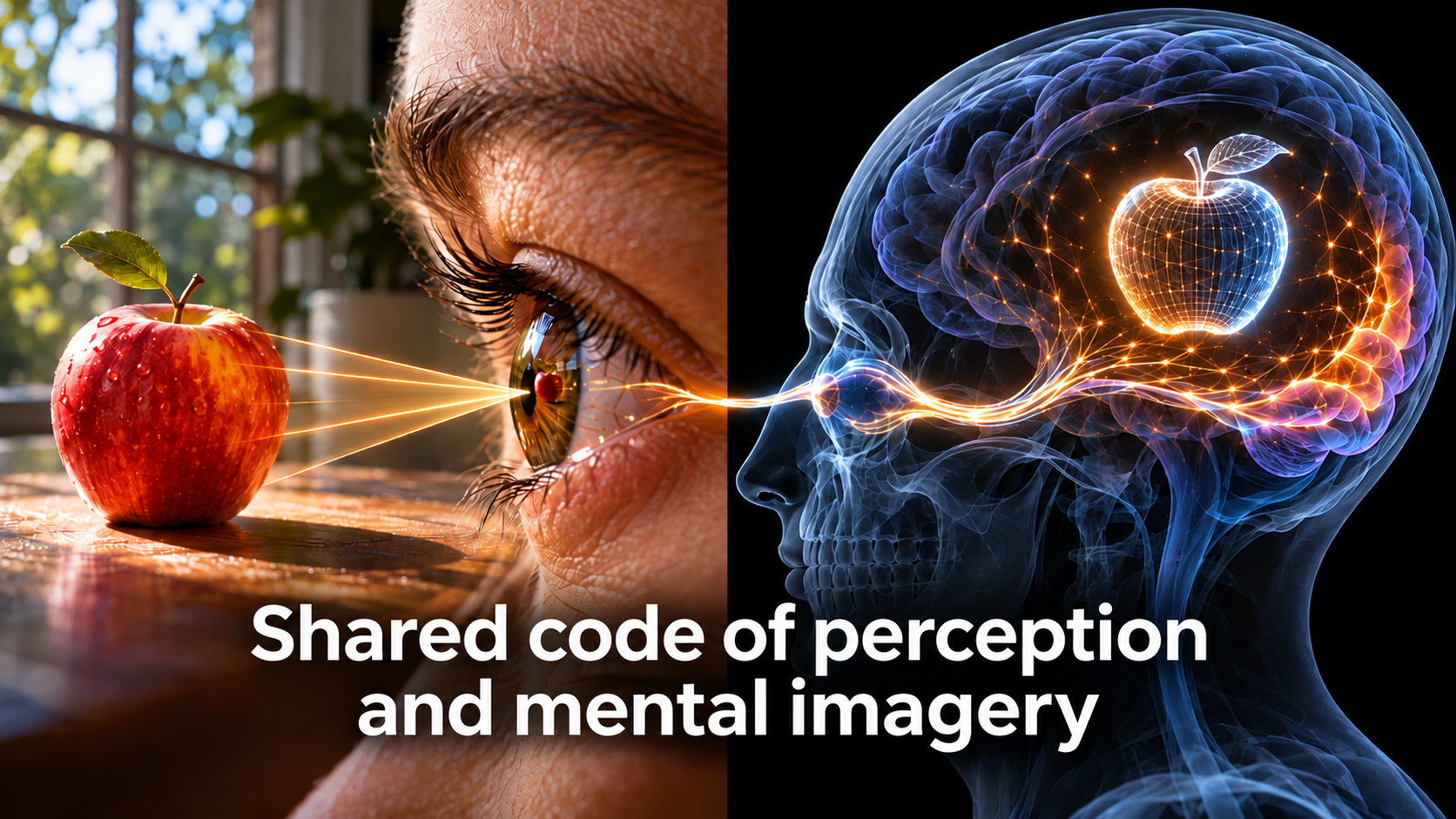
We treat imagination as a soft faculty. A daydream. A flight of fancy. Something distinct from the hard, empirical work of perception—the eyes open, the world enters, the brain records.
The neuroscience says otherwise. Mental imagery is not a separate process. It is perception run in reverse. When you visualize an apple, your brain does not think about apples in the abstract. It reactivates the specific neural code that fired when you last saw one. The mind's eye is not a metaphor. It is a borrowed set of hardware.
Let's dissect the evidence.
1. The Single-Neuron Proof: Imagining Uses the Same Code as Seeing
The most striking evidence comes from a 2026 study published in Science, led by researchers at Caltech and UC Berkeley. The team recorded individual neurons in the brains of epilepsy patients who had electrodes implanted for clinical monitoring. They showed patients images of objects, then asked them to imagine those same objects from memory.
The finding was precise: approximately 40% of the object-tuned neurons in the ventral temporal cortex that fired during perception were reactivated during imagery. More importantly, the pattern of activation was the same. The neurons were not just active; they were using the same code. A computational model trained on the perceptual responses could decode what the patients were imagining, based solely on the neuronal firing patterns .
This is not vague "overlap." It is evidence that imagination is, at the neural level, a replay of perception. The brain does not have a separate "imagination module." It has a perceptual system that can be driven from the top down, without the bottom-up input of light hitting the retina.
2. The Visual Cortex: A Screen for the Internal Eye
Earlier neuroimaging work established that mental imagery activates the primary visual cortex (V1) and surrounding areas, the same regions responsible for processing actual visual input . The activation is weaker than perception—imagery is a fainter signal—but it is present, and it is spatially organized.
Crucially, the activation is content-specific. If you imagine a large object, the activation in V1 spreads across a larger area, just as it would if you were actually seeing a large object at the same distance. If you imagine a detailed object, the high-resolution visual areas are recruited. The brain does not just "light up"; it simulates the spatial and featural properties of the imagined stimulus .
The visual cortex, in other words, is not a passive receiver. It is a screen that can be projected onto from the inside.
3. The Motor Loop: Imagining Movement Fires the Muscles' Command Centers
The same principle applies to movement. Motor imagery—mentally rehearsing an action without performing it—activates the premotor cortex, the supplementary motor area, and the cerebellum. These are the regions that plan and execute actual movement.
A 2019 review in Progress in Neurobiology summarized the evidence: observing or imagining an action excites virtually the same sensory-motor cortical network that supports execution of that action. The authors describe mental practice as "internal rehearsal," running the motor program offline without sending the command to the muscles .
This is why mental rehearsal works. The brain does not know the difference between a simulated action and a suppressed one at the level of the planning circuitry. It practices either way.
4. The Practical Consequence: Mental Practice Changes Performance
The behavioral evidence follows from the neural evidence. Meta-analyses consistently show that imagery training—systematically rehearsing a motor skill in the mind—improves actual performance. A 2024 meta-analysis of imagery training in children and adolescents found a medium positive effect (Cohen's d = 0.494) on motor performance .
The effect is not as strong as physical practice, and combining the two does not always produce additive benefits. But the fact that mental rehearsal has any measurable effect at all is a testament to the depth of the overlap. You are not "just thinking about" the skill. You are running the same neural program, at a lower amplitude.
5. The Boundary Problem: Why Don't We Hallucinate All the Time?
If imagination uses the same pathways as perception, why don't we confuse the two? Why doesn't visualizing an apple make us reach for it?
The answer appears to lie in a gating mechanism. The thalamus, a relay station deep in the brain, normally suppresses internally generated signals when external input is present. During imagery, the top-down signal is allowed through, but it is tagged as internally generated. The gate holds.
When the gate fails—through trauma, psychosis, or extreme fatigue—the boundary collapses. The internally generated image becomes indistinguishable from the externally perceived one. This is the neurobiological basis of hallucinations: not a failure of imagination, but a failure of the gate that normally keeps imagination in its place .
The Unspoken Conclusion: The Brain Is a Simulation Engine
Mental imagery is not a curious sideshow of cognition. It is the default mode of the brain's operation. The brain is not primarily a passive receiver of reality. It is a simulation engine, constantly generating predictions, running models, and constructing experience from the top down.
Perception is not the brain's primary function. It is a correction mechanism—a way of calibrating the simulation against external input. Imagination is the simulation running without correction. Both use the same machinery. Both are real, in the only sense that matters to the brain: they are patterns of neural activation that constitute experience.
When you visualize, you are not escaping reality. You are using the same hardware that constructs reality, freed from the constraints of the senses. The mind's eye is not a metaphor. It is a second sight, built from the same tissue, running on the same code.